The Flash Archives Volume 6 Foreword

Originally published in The Flash Archives Volume 6 in 2012.

By 1964, The Flash was humming along like a finely tuned machine. Editor Julius Schwartz, writer John Broome, and artists Carmine Infantino and Joe Giella had hit their strides on the book, providing a consistency that was, arguably, unmatched by any other title in the DC Comics/National Periodical Publications line, including even those that were also edited by Schwartz.
Over in editor Mort Weisinger’s Superman titles (Superman, Action Comics, Superboy, Superman’s Girl Friend, Lois Lane, Superman’s Pal, Jimmy Olsen), the order of the day was to appeal to a ten-year-old reader with a Man of Steel who acted more like a ten-year-old himself than the most powerful man in the universe — playing pranks on his friends to teach them lessons or to prevent them from uncovering his secret identity, or tricking the constant stream of gangsters in suits he encountered into revealing their plans and/or their secret weapons. Even Superman’s greatest foe, the brilliant scientist Lex Luthor, was motivated by adolescent spite — he wanted “revenge” against the Metropolis Marvel for the long-ago laboratory accident he blamed on Superboy that caused him to lose his hair.
Jack Schiff’s Batman titles (Batman and Detective Comics) were even more ridiculous, pitting the Caped Crusader and the Boy Wonder against a silly array of aliens, super-scientific gimmickry, and, of course, Bat-Mite. (Schwartz would, incidentally, take over the editorial reins of Detective Comics in early 1964, introducing the “New Look” with art by Infantino and, more importantly, a new tone, which was actually the old, original tone: Batman as a detective solving down-to-Earth crimes with deductive reasoning).

Elsewhere, Aquaman was battling giant clams, the Metal Men were played for melodramatic and goofy laughs, the Blackhawks went up against angry giant Mayans (for real: Blackhawk #193, February 1964: “Valley of the Angry Giants” — look it up), and writer/editor Bob Kanigher’s Wonder Woman had become a fairy tale, with the Amazing Amazon and her teen and toddler counterparts, Wonder Girl and Wonder Tot, spending their time with Mer-Boy and Bird-Boy, depressed genies, and fire-breathing dragons.
The rest of the DC line was genre adventure (Sea Devils, Tomahawk, The House Of Mystery), romance (Young Love, Secret Hearts), war (Our Army At War With Sgt. Rock, G.I. Combat), and humor (The Adventures Of Jerry Lewis, The Adventures Of Bob Hope, Fox And Crow). Frankly, the only other title in the DC lineup giving Schwartz’s books any kind of run for their money was the Murray Boltinoff-edited Doom Patrol by Arnold Drake and Bruno Premiani — a collection of “outcasts and freaks” that beat the X-Men to the newsstands by a couple of months.
It’s no surprise that Julie Schwartz filled the role of editorial outrider at DC. He was a story man from way back when, and he had spent a dozen years as a literary agent to some of the biggest names in science fiction before he ever even read a comic book (on the subway ride to the job interview at DC in February of 1944). His knowledge of, and comfort with, the art side of the equation came later; for the most part, however, he simply knew what he liked and hired the guys who provided it. It’s no coincidence that the bulk of his books were mostly drawn by the same small stable of artists, all of whom were among the very best the medium ever produced, including Infantino, Gil Kane, Alex Toth, Murphy Anderson, and Mike Sekowsky.
Of course, in all fairness and with a retroactive awareness of what Stan Lee, Jack Kirby, Steve Ditko, and others were doing at Marvel in those same years, comic books in 1964 were being produced largely with the ten-year-old reader in mind. If anyone had ever suggested to the publishers of the day that the audience for comic books would one day consist mostly of adults, they would have been laughed out of the room. Not even Julie thought the medium would ever wind up there.
But the difference between Schwartz and his DC peers was that Julie didn’t underestimate the intelligence of the adolescents buying his books. One assumes that Julie’s titles sold at least as well as those edited by his colleagues, since not only did DC continue to publish them, but when it came time to re-imagine yet another Golden Age character for the modern market — a trend he started with the Flash in Showcase #4 in 1956 — it was usually Schwartz who was handed the gig.

It’s probably not a coincidence, then, that it was not Stan Lee and Marvel that sparked the emerging flame of comics fandom in the hearts of young adults like Jerry Bails, Biljo White, and Roy Thomas, but was instead Julie Schwartz’s Justice League Of America, Detective Comics, Green Lantern, The Atom, Hawkman, Adam Strange, and, of course, The Flash.
So, what made The Flash stand out from the rest?
All the above reasons aside, it was, plainly and simply 1) the Flash’s incomparable Rogues Gallery, and 2) perhaps one of the greatest run of covers ever to appear on any comic book series.
Superman limped along with just two top-tier villains: Lex Luthor and Brainiac; after that, what were you left with? Toyman? Titano, a King Kong wannabe with Kryptonite-vision? The absurd Mr. Mxyzptlk?
Batman had some great bad guys (the Joker, Catwoman, the Riddler, Clayface, Scarecrow), but they appeared infrequently, and in stories that never seemed to have very much at stake for either the Dark Knight Detective or his antagonist. The truly scary and dangerous Joker associated with Batman today was still a good decade in the future, in stories like the Denny O’Neil/Neal Adams classic “The Joker’s Five-Way Revenge!” in Batman #251.
But the Flash?

Count ’em out: Captain Cold, Mister Element/Doctor Alchemy, the Mirror Master, Gorilla Grodd, the Pied Piper, the Weather Wizard, the Trickster, Captain Boomerang, the Top, Abra Kadabra, Professor Zoom — the Reverse-Flash, Heat Wave, and T.O. Morrow; all introduced within the first half dozen years of the Scarlet Speedster’s Silver Age run, all of them not only nasty but also willing and able to kill the Flash. These villains had the feel of reality about them; they came equipped with gizmos and gimmicks not based on nonsensical comic book “hand-wavium” pseudoscience, but on real scientific facts.

Yes, of course, Trickster’s flying jet-shoes, Weather Wizard’s weather-controlling wand, and Doctor Alchemy’s element-transmuting gun were total fabrications of Broome and Schwartz’s imaginations. Julie knew, of course, that none of it was real, or even possible in anything resembling the near future. But he insisted that all of these exaggerated bits of business were grounded, at least partially, in some scientific reality. In The Flash #142’s “Perilous Pursuit of the Trickster,” when the fleeing villain creates a rainstorm to cover his escape, he uses “special silver iodine crystals,” which are, as an Editor’s note explains, used by science to “seed” clouds to make rain. He utilized non-story filler pages in the book to present “Flash Facts” — not facts about Barry Allen or his alter ego, but actual facts about various aspects of velocity and speed in the real world (“When certain stars (called novae) flare up to intense brightness, gases are expelled from their surfaces at speeds of about 1000 miles per second...”). Even the “magic” in The Flash had one foot in science; the magical Abra Kadabra is, in fact, a time-travelling citizen of the 64th century, employing science so advanced that it seems like magic to us 20th century primitives.
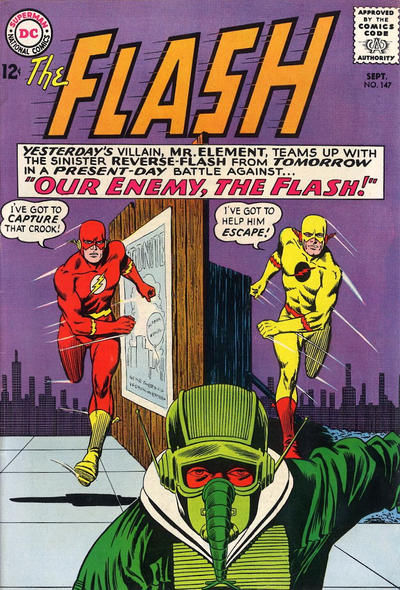
Nor were Schwartz and Broome shy about using their Rogues every chance they had. In the nine issues reprinted in this volume alone, we are treated to appearances by the Trickster, T.O. Morrow, the Weather Wizard, the Mirror Master, Mister Element, Professor Zoom, and Abra Kadabra. Team-ups among villains were not uncommon either; readers could actually envision some of these guys getting together to commiserate over their repeated defeats at Flash’s fleet feet before teaming up to try and destroy him en masse (as they did in issue #130’s “Who Doomed the Flash?”). In The Flash #147, Professor Zoom makes the journey from the 25th century to join forces with Mister Element, the only man capable of finding a way to make permanent the effects of the super-speed inducing “element Z” (for “zoom”).
And there were the covers. Those magnificent, perplexing, and wonder-inducing covers.
These days, covers seem to be little more than variations of posed poster shots, an endless run of pretty but pointless pictures slapped over the stories to keep the interior pages from getting wrinkled. But back then, when kids were kids and comics were for kids, before readers knew through the internet what was going to be in their favorite books months in advance, a comic book cover was a sales tool. The youngster walking into his local candy store or drugstore had no idea what he (and it was mostly boys) was going to find on the spinner rack that week, let alone what the stories contained within were about. It was the covers’ job to grab the buyer’s attention with an intriguing or impossible image that made him want to, have to read the story to find out. Chances are that kid only had enough cash on hand to buy one or two of the dozens of titles available to him. A cover that made him say, “What the...?” or “It can’t be!” greatly increased that title’s chances of being bought.

Julie Schwartz specialized in the intriguing cover, and he brought it to a state of high art on The Flash. Classic examples abound, right from the starting line: Flash’s second appearance in Showcase #8 (May-June 1957) had the speedster being stopped dead in his tracks by a mysterious hand whose off-panel owner boasted “I can beat you with one finger!”; The Flash #107 (June-July 1959) has the Flash being beaten in a race by an ordinary guy in track shoes...running backwards; the Mirror Master returns in #109 (October-November 1959), using one of his trick mirrors to shrink the Fastest Man Alive down to nothingness; the Trickster’s debut in #113 (June-July 1960) features the colorful rogue fleeing the Flash by running off a cliff and through the air!

But he really struck gold beginning with The Flash #115 (September 1960), “The Day Flash Weighed 1,000 Pounds!”, with a cover that showed the speedster being transformed into a half-ton tub: “... Becoming so fat... >Puff< I can hardly run...”! That was followed in short order by such classics as #122 (August 1961) “Beware the Atomic Grenade!”, #123 (September 1961) “Flash of Two Worlds!”, #126 (February 1962) “Doom of the Mirror-Flash!”, and perhaps the most razzed but greatest cover ever, The Flash #133’s (December 1962) “Plight of the Puppet-Flash!”, wherein a painted wooden Pinocchio-like Flash, running past a poster of Abra Kadabra that is bathing him in energy with its magic wand, thinks to himself, “I’ve got the strangest feeling I’m being turned into a puppet!”
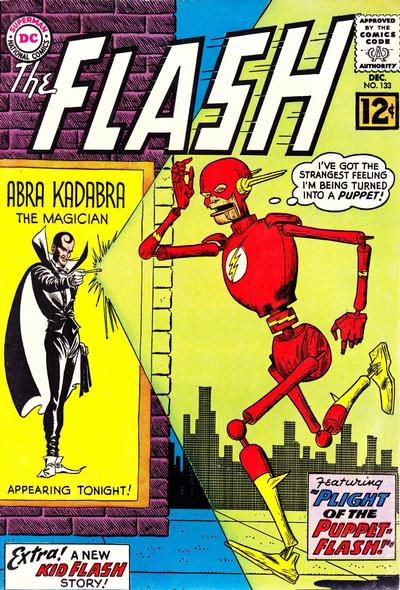
I dare you to be ten years old in 1962 and pass that one by!
And yet, for all the fantastic comic books and must-read covers represented in this and the previous five volumes of The Flash Archives, one of the most amazing Flash-facts is that Schwartz and company would continue this breathtaking run for several more years to come. The Rogues got nastier, the covers kept readers coming back for more, and through it all The Flash never broke stride, maintaining its first place position in a pack that would have left a lesser comic book in the dust.


Comments