WONDER WOMAN: THE AMAZON PRINCESS ARCHIVES VOL. 1 , Foreword

Originally published in Wonder Woman: The Amazon Princess Archives, Vol. 1 (DC Comics, 2012).

Nearly twenty years after her introduction—and more than a decade after the death of her original writer and creator—Wonder Woman was about to take a radical turn from her already radical beginnings.
The brainchild of Dr. William Moulton Marston, the Amazing Amazon first saw the light of day in All-Star Comics #8 (December 1941-January 1942) and began her monthly adventures in Sensation Comics #1 (January 1942). Marston, born in Massachusetts in 1893, was a Harvard University-trained psychologist (he also possessed a law degree and was a teacher, inventor, and writer as well) and a strong advocate of feminism. In a 1937 New York Times interview, he favorably predicted the feminist movement based on his belief, according to Les Daniels’s Wonder Woman: The Complete History (Chronicle Books, 2004), that “women were less susceptible than men to the negative traits of aggression and acquisitiveness and could come to control the comparatively unruly male sex by alluring him.”

Marston developed a successful career as a consulting psychologist, advancing his theories and promoting himself by working closely with big business and the entertainment industry. As a member of their board of advisors, he challenged the publishers of National Periodic Publications (the precursor of DC Comics) to create comic book heroes that would provide young readers with sound and worthy role models based on current psychological theory. National answered his challenge by handing him the assignment. His response was the creation of Wonder Woman, whose adventures he went on to write (with art provided by H.G. Peters) under the pseudonym Charles Moulton until his death in 1947.

Marston’s reasoning for creating Wonder Woman was summed up in a 1943 article he wrote for The American Scholar magazine: “Not even girls want to be girls so long as our feminine archetype lacks force, strength, and power. Not wanting to be girls, they don't want to be tender, submissive, peace-loving as good women are. Women's strong qualities have become despised because of their weakness. The obvious remedy is to create a feminine character with all the strength of Superman plus all the allure of a good and beautiful woman.”
He expanded on his feminist ideas in a letter to early comics historian Coulton Waugh (author of 1947’s The Comics): “Frankly, Wonder Woman is a psychological propaganda for the new type of woman who should, I believe, rule the world. There isn’t love enough in the male organism to run this planet peacefully... What woman lacks is the dominance or self assertive power to put over and enforce her love desires. I have given Wonder Woman this dominant force but kept her loving, tender, maternal, and feminine in every other way.”
After his death Marston was replaced by writer/editor Robert Kanigher, who hewed, more or less, to the doctor’s original, feminist vision of the character... for about a year. Then declining sales overcame ideology, and the super-heroine designed to be a role model to inspire feminine strength, and self-reliance was turned, in essence, into the lead of a romance comic with a super-hero setting.
With this shift, the title’s stories became less about girl power and more about the trials and tribulations of being a girl. Many of them centered around the ongoing relationship between Wonder Woman and Colonel Steve Trevor, the aviator whose appearance on Paradise Island was the original impetus for the Amazon’s contest to choose a champion to escort him back home to America. Steve, who had once played the role of rescuee—the Lois Lane to Wonder Woman’s Superman—was now the pursuer, seeking the hand of this “angel” who, either through dedication to duty or insecurity (depending on each particular story’s needs) found every possible excuse to avoid matrimony. A new, decidedly feminine—in the clichéd, 1950s “helpless female” sense—role replaced her feminist origins.
Of course, Bob Kanigher hadn’t come to comic books with anything resembling Marston’s feminist credentials. Born in 1915, he wrote short stories, radio scripts and stage plays before moving into comics, where he honed his skills on such characters as the Blue Beetle, Steel Sterling, and Captain Marvel for MLJ and Fawcett before landing at National in 1945 to provide scripts for features like the Flash, Green Lantern, and Johnny Thunder.
Kanigher was legendary for his speed and his tremendous output. In a career that lasted almost until his death in 2002 at the age of 86, he set the record as DC’s most prolific writer, turning out almost 2,700 stories in every genre totaling over 30,000 published pages. (In comparison, his closest rival in prolificacy is Gardner Fox, with a “mere” 1,500 stories/17,700 pages.) Whereas Marston had a message to deliver, Kanigher’s primary objective was simply to deliver scripts as fast as possible.
Kanigher’s forte was, in fact, the rough and tumble macho world of war comics, the genre in which he achieved his greatest fame and did his best, most lyrical writing. From 1952 through most of the 1960s he was responsible for both the editing and the majority of the writing for all of DC’s war titles, for which he created his most memorable characters: Sgt. Rock, Gunner and Sarge, Enemy Ace, the Unknown Soldier, Haunted Tank, Balloon Buster, and more. This isn’t to say that Kanigher couldn’t handle strong female characters; from his vast and fertile imagination also came Black Canary, Rose and the Thorn, and Mademoiselle Millie, but these were the exceptions in his generally testosterone-fueled oeuvre.
In 1958, DC was poised on the cusp of a grand revival largely spearheaded by Kanigher’s fellow editor, Julius Schwartz. At a time when Superman was offering harmless juvenile male fantasies of super-powered hijinks and Batman was featuring science fiction-based tales about a detective who did no detecting, Schwartz was slowly building a new super-hero age, beginning with his freshly renovated version of the Flash in Showcase #4 (October 1956)—written, coincidentally, by Kanigher—and followed by Adam Strange (Showcase #17, November 1958), Green Lantern (Showcase #22, September 1959), the Justice League of America (The Brave And The Bold #28, February 1960), and the Atom (Showcase #34, September 1961).
Editor/writer Kanigher’s response to these changing times was a makeover for Wonder Woman that was more radical in style than in tone. H.G. Peters had drawn virtually all the Amazon Princess’s appearances since her debut in 1942, but Kanigher felt that the 78-year-old artist’s work was not only outdated but had deteriorated in quality as well. It was time for a change, and to replace Peters Kanigher chose a duo familiar to readers of his war titles: penciller Ross Andru and inker Mike Esposito.
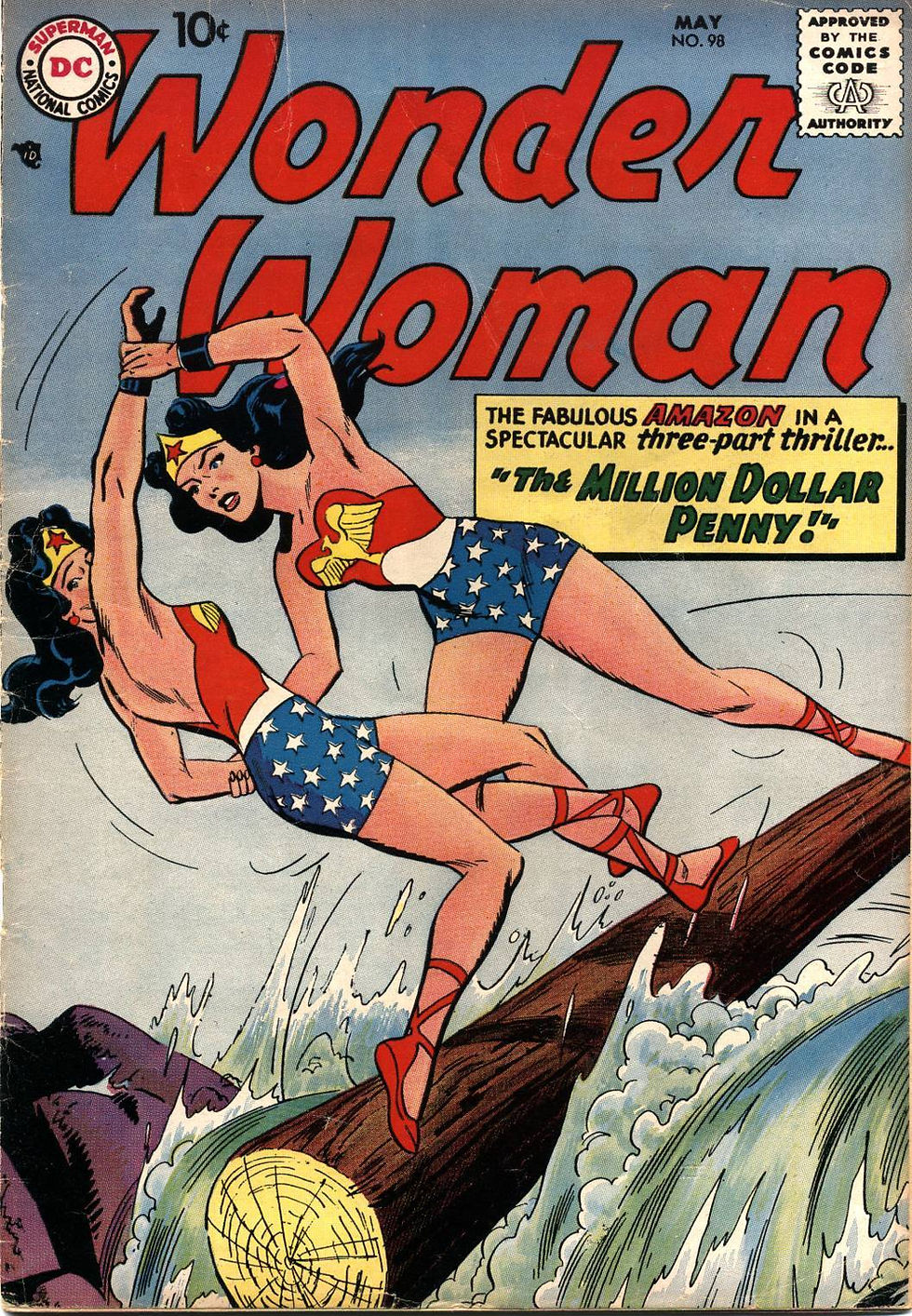
Readers who picked up Wonder Woman #98 (May 1958) found an Amazing Amazon very different in appearance from what they had been accustomed to. Gone was Peters’s antiquated, illustrative, and (to some) quasi-grotesque artistic take, replaced by the slick, dynamic art of the Andru and Esposito team. A brand-new take on Wonder Woman’s origin also accompanied this change in style—like the comic book industry in general, Kanigher was not overly concerned with continuity in those bygone days. Following the commonly accepted wisdom that the comics-buying audience changed every five years or so as readers outgrew them, writers back then felt free to take whatever liberties tickled their fancies.
In that spirit, “The Million Dollar Penny!” adds a few twists to the character’s accepted introduction to the world. Princess Diana, daughter of the Amazon queen Hippolyta (now a blond after almost twenty years as a brunette), is pictured wearing the red, white, and blue Wonder Woman costume even before she competes in the contest to choose an Amazon champion to go to “man’s world to battle crime and injustice—and help people in distress,” as per the goddess Athena’s command. (In a set-up for the forthcoming romantic kerfuffles with Steve Trevor, Athena adds, “Only when her services are no longer needed can she think of herself!”)
In order to keep Hippolyta from favoring Diana while judging the contest, all the Amazon contestants don Wonder Woman costumes as well as masks of Diana’s face for the competition. (Wouldn’t it have been easier for the women to wear non-descript clothing and cover their faces with plain masks or helmets? Some questions are better left unanswered.) Diana, of course, triumphs, and is declared by her sisters to be a “wonder woman indeed!” So, Hippolyta sends her off to man’s world with a mission: to turn a single penny into a million dollars to be used to build a children’s summer camp!
It’s at this point that Steve Trevor enters the scenario, bailing out of his failing aircraft with a defective parachute right above Paradise Island—where Athena’s law dictates that the Amazons will lose all her powers if a man ever touches the ground. I’m not giving too much of the story away when I tell you that Diana manages to prevent this particular catastrophe.
With all the pieces in place, Wonder Woman and Steve head back to man’s world to begin her adventures and their courtship. He calls her his “angel”; she refers to him as “darling.” He pursues her with the single-minded determination of a love-struck high school boy; she avoids commitment like someone afraid of losing a bet.

It is, in fact, just such a bet that leads her to assume a secret identity in Wonder Woman #99. In “Top Secret,” Steve confesses that he can’t live without her, that he loves her so much that he “could pick [her] out if [she] were just a single grain of sand on a beach.” Touched (but quick to remind him that she can’t marry him while her services are still needed as Wonder Woman), Diana agrees that if he can pick her out of crowds three times in twenty-four hours, she will marry him. Against impossible odds, Steve does indeed find her the first two times (he’s cheating, that scamp!), but fails in his third attempt, even after Wonder Woman is introduced to him in the form of his bespectacled new assistant, Lieutenant Diana Prince. In the DC Universe, there’s nothing better to hide behind than a pair of glasses. Just ask Clark Kent.

From this beginning Kanigher rapidly introduced all of the tropes that would quickly become trademarks of the character for the rest of the Silver Age: bets with Steve Trevor for her hand in marriage, Wonder Woman doppelgängers, gigantic fairy tale beings, mythological beasts, creatures from out of time, natural disasters, battles with monstrous predators (in #103 alone she faces a polar bear, a killer whale, a giant hawk, and a shark), alien invaders, Steve’s military missions going horribly awry, and retellings of her origin (#105’s “The Secret Origin of Wonder Woman” introduces young Diana as Wonder Girl, and #107 features an adolescent “Wonder Woman, Amazon Teen-Ager!”). Kanigher endlessly mixed and matched these elements for an infinite variety of stories, each one sillier than the last, but all so fast-paced and action-packed that the young readers of the era scarcely had time to catch their breath, let alone parse the stories for logic. Reality, of course, wasn’t even an issue. These were romantic fairy tales for kids and, as such, they delivered everything they promised.

Kanigher would not relinquish editorial control of Wonder Woman until the middle of 1968, when new editor Jack Miller would hand the creative reins to writer Dennis O’Neill and artist Mike Sekowsky for their memorable (and sometimes mocked) revamp in which they replaced Diana’s costume with Carnaby Street mod clothing, Queen Hippolyta with blind martial arts master I-Ching, and Wonder Woman’s super-powers with ju-jitsu. If the approach was somewhat ill-informed, at least it was an honest attempt to set aside the past decade’s silliness and return the character to her feminist roots.
For the duration of the Donna Reed Show 1950s and the Leave it To Beaver 1960s, however, the Amazing Amazon would continue fighting dragons and giants in a fairy tale world. Maybe she wasn’t the Wonder Woman that Dr. Marston envisioned, but she certainly seemed to be the Amazon Princess her readers wanted.


Comments