Impact Comics: The Little Imprint That Was Left Out in the Cold: Part 1 “Nightmare-On-Wheels”

Originally published in Back Issue #118 (February 2020).
DC Comics "all ages" line of Impact Comics, featuring the superheroes licensed from Archie Comics, launched in 1991 and made an attempt to revamp and relaunch in 1993. It didn't go as planned...

“Why bother?”
Let me start by offering this Pro Tip: When you’re an editor writing a proposal to pitch a new multi-title project to your publisher, it’s usually not a good idea to lead with “Why bother?” You should also avoid such information, even buried in the proposal’s sixth paragraph, that the project “...isn’t going to sell. Let me say that again. (It) will not, in even the long term, be a major commercial hit. The industry as it presently exists will not support efforts with as many negatives as (this project has).”
Posing such questions and making bold statements of defeat right off the bat aren’t usually the way to a project go-ahead. But in the case of DC Comics editor Jim Owsley’s proposal for the re-launch of the revamped Impact Comics line, he knew he was dealing with a hostile audience and couldn’t afford to be accused of “wishful thinking” in his pitch for The American Shield, The Mark of the Black Hood, and The Wrath of the Comet by confidently predicting great sales success.
The fact of the need for a re-launch after only about a year and a half of the original six Impact! titles made that claim impossible.
He mentions some of the reasons he believed the line failed, including the lack of “a consistent editorial point of view and voice” that resulted in some titles “presenting material juvenile in some instances and extremely graphic in others” and failures in marketing. Indeed, the eight-page memo contains a running sidebar, called “It’s Never Been Boring...,” about which Owsley notes, “The following (more for my own benefit) is a brief-recap of the Impact re-launch nightmare-on-wheels”; it is a footnoted timeline (in 8-point type) beginning with a disastrous Impact Comics creative summit in Chicago on November 12-15, 1991 to about a month after the January 7, 1993 launch of Crucible: Final Impact #1 (the six-issue miniseries that was to serve as the lead-in to the re-launch), when the editor is still butting heads with administration and marketing over getting the project done.

But despite the negatives, Owsley’s memo, entitled “Is Impact Dead? Notes on the Impact Re-launch,” went on to enumerate the reasons why DC should keep the line going, including the belief that the original “target audience...(of) boys aged eleven to fourteen...the bulk of our target audience, and boys aged eight to eleven who are somewhat precocious” it was designed to reach was still out there, a potential market still waiting to be tapped.
But First...
A disclaimer: I was the editor of two of the original Impact! titles (Len Strazineski and Mike Parobeck’s The Fly and Mark Wheatley and Rick Burchett’s The Black Hood) and wrote several issues of The Crusaders and The Web and was involved in the re-launch in both an editorial capacity (“October 19-21, 1992 - Waid, Augustyn, Kupperberg and I blow off three days and plot the re-launch books. Morale is very low.”) and as the writer of the five-page “Steel Sterling” back-up series that was scheduled to run through the re-launch titles.
And some background: In late 1989, the DCU’s Development Group pitched the idea for a kid-friendly line of comics, a separate imprint for younger readers. “We certainly will be attracting a large number of traditional super-hero readers...however they generally look to DC Comics for a different type of story. We must not take this built-in audience for granted,” a later proposal warned, but always keep in mind the mission to attract a new audience to the generally dwindling ranks of young comic book readers. The new imprint was to be “kid friendly,” an antidote to the growing industry trend of “grim and gritty” heroes and stories.
Rather than depending on a line-up of newly created characters to headline the new imprint, the choice was made instead to license an already existing cast of heroes from another publisher. To that end, DC approached the publishers of Archie Comics and struck a deal to license their dormant line of superheroes, which had last seen light in their short-lived 1983-1985 Spectrum Comics.
Impact! Comics launched in July 1991, beginning with The Fly, and followed by The Comet, The Legend of the Shield, Jaguar, The Web, The Black Hood, and The Crusaders. The talent on these books was considerable—artists Mike Parobeck, Rick Burchett, Tom Lyle, David Antoine Wiliams, Grant Miehm, Rags Morales, and Tom Artis, and writers Mark Waid, William Messner-Loebs, Mark Wheatley, Len Strazewski, and Brian Augustyn—but after an initial rush of enthusiasm and promotional support, Impact! Comics began a steady, troubled seventeen-month slide to cancellation. Creative issues and deadline problems had been common almost from the start; as early as February of 1991, one of the creators wrote a one and one-half page letter outlining his concerns about previously agreed upon ideas that he felt had been “lost or thrown aside” and ended by confessing that his “enthusiasm and commitment to [his title] has been severely reduced by the problems I’ve outlined above.”
By the end of 1992, after numerous editorial and creative changes, seventy-nine monthly issues, four annuals, one Winter Special, and three issues of Who’s Who in the Impact! Universe, the Comet had destroyed Evergreen, a major city in the Impact! U, the rest of the superheroes had mysteriously vanished from Earth, and Impact! Comics was history.
Or...was it?
In the early 1990s, DC editor James Owsley put together a document entitled “Edited by Owz: A Comprehensive Guide to Surviving the Jim Owsley Experience (Previously Published as ‘Do It My Way or Die’),” a sort of editorial guide and brief treatise on the care and feeding of this particular editor. It’s an entertaining read (which DC’s editorial administration forbade him from distributing to his freelancers), beginning with an introduction, “What Do You Want? Or I’m Not Your Mom,” for which Jim lifted a portion of a text piece I had earlier written for the letter page in the Owsley-edited Arion the Immortal miniseries: “(Owsley’s) door is usually closed. More often than not there’s a bevy of freelancers circling with lost looks outside his door, peering nervously through the pebbled glass panel at the hunched over, hell-bound editorial figure silhouetted in the eerie glow of his halogen desk lamp.... Owsley is a man with an attitude, and that attitude is, ‘I’m in hell!’”
Jim Owsley began his career at Marvel Comics as an intern when he was seventeen; by twenty-two he was in charge of the Spider-Man line as the first African American editor for a major U.S. comic publisher, and in 1990, the editor and writer moved over to DC Comics, where he found fresh levels of hell when he assumed the editorial reins of Impact! Comics. While some of the titles plodded along with relatively little fuss, others ran into creative disputes, deadline pressures, and personality conflicts. For various reasons, the books were being handed off to editors who hadn’t been in on the planning and birth of the line (myself included), and Impact’s much vaunted cohesion quickly eroded as the original supervising editor’s attention drifted to other, newer projects.
Comic book heroes can survive any foe except low sales. By the end of the 1991, the writing was on the wall, but DC had decided to give the Impact! Comics line a second shot, based on Owsley’s publishing plan, “Is Impact Dead?” In the “It’s Never Been Boring” sidebar, he notes on December 17, 1991, “The Impact Re-launch plan...submitted to Dick. The plan calls for an interruption of all Impact titles except The Crusaders, which should provide a continuity out of which the new series would launch.” On February 27, Owsley notes, “(Executive V.P. and Publisher) Paul (Levitz) suggests rather than continuing Crusaders, launch a mini instead. (V.P.-Sales and Marketing) Bruce (Bristow) agrees, preferring a bridge to an ‘isthmus.’ Paul further suggests the mini needs to encompass the changes to the Impact Universe, rather than just deal with our current heroes’ long journey home.”
The Impact re-launch (one of the first things Owsley did was lose the juvenile-looking exclamation point from the logo) was “designed and executed to capture the imagination of younger readers and to provide them with a sophisticated, cohesive universe with which to introduce them to super-hero comics.” That effort began with a six-issue miniseries, Crucible (February 1993) that picked up the story of the Impact Universe six months after the disappearance of the heroes.
Into the Crucible
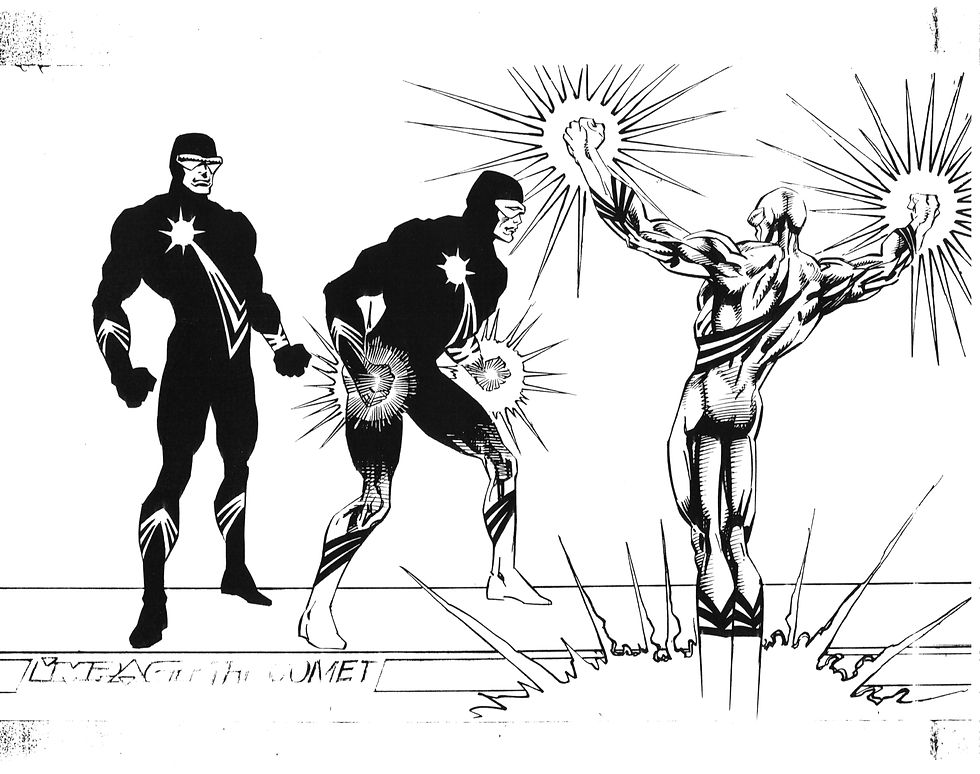
To write the miniseries and the subsequent ongoing monthlies, The American Shield, The Mark of the Black Hood, and The Wrath of the Comet, Owsley tapped Mark Waid and Brian Augustyn, two of the members of the original Impact! creative crew. The use of a single team of writers sharing the workload was key to Owsley’s concept of Impact; to his mind, the lack of a single guiding editorial vision and creative voice were major causes behind the failure the first time around.
For an artist, Owsley’s decision was guided by marketing. He wrote that on March 6, “Paul wants to announce something—anything—good about Impact at the following week’s sales meeting. At 3:30PM Friday he asks me if I can sign on name talent and get a piece of display art ready in time for the (sales meeting) cruise, which (departs) on Monday. I contact Joe Quesada and Joe Rubinstein and call in a truckload of good faith.” The following day, a Saturday, Owsley “orchestrate(s) the creation of a sales book page for Evergreen [the miniseries’ working title] ...Quesada finishes the promo art (in a big hurry) and takes a cab to Brooklyn so Rubinstein can ink.”
Quesada, a rising star in comics, thanks in part to his run on the Owsley-edited The Ray and as co-creator with Denny O’Neil of Azrael over in the Batman line, had agreed to do the layouts for the miniseries, which told the story of a world transformed by a miraculous technology created by Mr. Jordan, a supposedly benevolent genius and the inventor of the Room Temperature Semiconductor, and the machinations of the Tomorrow Men. The latter were a group of businessmen who had discovered the Crucible, a place at the center of time, and were employing the futuristic technology they found there to make themselves rich and control the destiny of the world.
Owsley made an official request to “go to first issue,” i.e. start work on Crucible #1 on March 24, and the next day, according to the timeline, “Dick (Giordano) stops Paul Kupperberg in the hall and says, sure it’s okay to go to first issue.” The next step was to lock in a penciller to finished Quesada’s layouts, but as with most steps on the road to the Impact Comics re-launch, this one met with its own share of stumbles. The editor wanted to give the assignment to Chuck Wojtkiewicz, a solid, dependable artist and storyteller who had more than earned his place at the re-launch table for his hard work on the original line. But according to Owsley’s timeline, Joe Rubinstein, who was already onboard to ink the miniseries, “won’t do it” if Wojtkiewicz was chosen. The inker and Quesada had suggested Steve Carr, but as of April 16, “Steve Carr refuses to do Crucible unless his partner, Daryl Skelton, is (also) credited. Rubinstein reminds me he won’t do it unless Carr does. I speak to Paul (Levitz), who grabs his head and sighs loudly, but agrees to Daryl’s inclusion.”
By mid-June, the plots for the first four issues of Crucible had been approved and Quesada had delivered the first of his layouts, which were passed to Steve Carr. Meanwhile, the editor had submitted a “second request for official paper on our ‘go to first issue’ for the re-launch titles” since, without paperwork, no matter who says what to who in the hall, nothing was actually official; the wheels of administration finally, slowly ground it out by September 1.

Things Fall Apart Some More
In the meantime, the drama surrounding the creation of the miniseries continued to be every bit as tense as the story line itself. On August 4, Steve Carr’s first five pages arrive, but they are, according to Owsley, “out of sequence, and he’s modified my design specs for one of the characters. I ask him for corrections, and Steve demands to be paid. He also refuses to work in sequence.” After more give and take, Owsley is “at an impasse. I remove Steve and Daryl from the Crucible project.”
The following day, Owsley shared his decision with Giordano, reminding him that Carr and Rubinstein had come to the miniseries as a package. “Dick sez you’re the editor,” Owsley wrote, “but goes down to talk to Paul. Paul agrees to let Dick handle it.” Dick, as was his practice, backed the decision of his editor. “Chuck is in. Rubinstein walks. Jimmy Palmiotti comes aboard as inker.”
On August 10, a memo from editorial administration reminded the editor that as “no paperwork exists for a ‘go to first issue’ for the re-launch titles...none of my creative people can be paid.” Even while that was being straightened out, the question of kill fees and new deals and payments for the replacement talent had to be addressed, rising the temperature inside the Crucible between editorial and administration. The marketing of the miniseries was also proving problematic. Their plan was to price the first issue at .99¢ and go with the slogan, “Great New Story! Great Low Price!” As Owsley noted on September 22, “The morale of everyone involved takes a major hit.”
Owsley countered with a house ad of his own “the Quesada sales book piece modified somewhat,” but marketing felt it was too “quiet” and wanted to take a more traditional superhero approach. I resisted the suggestion, explaining that superheroes—no matter how well drawn—will look much the same. The Quesada piece involves puzzlement as to what we’re up to.” Nonetheless, his house ad “vanishes from circulation, replaced by the superhero one. My morale takes another hit.”
The last hit comes on February 2, 1993, when Owsley notes, “citing over-commitment and delays on our end (true), Joe Quesada reluctantly resigns from doing Crucible layouts, although he will remain on covers.” It’s left in Chuck Wojtkiewicz’s able hands to provide his own layouts for the final two issues of Crucible.
All the body blows aside, momentum, perseverance, and luck kept the Impact Comics team moving forward and, in the first week of January 1993, Crucible: The Final Impact #1 (priced at .99¢) landed in comic shops across the country.

Three weeks later, on January 28, Owsley noted that a member of the marketing group “is seen, by me, wandering the halls grinning as he recounts the lack of reorder activity on Crucible.”
In “Is Impact Dead?” Owsley expressed his hope “that Impact may exist as three or four titles, off in a corner somewhere, existing quietly and without hype.” But to accomplish that, he first had to get the first issues of the three re-launch titles finished in order to prove he had the goods.
The nightmare-on-wheels was still rolling.
Stay tuned for Part 2!


Is the Jim Owsley proposal anywhere online? I just did a quick Google search and didn't see it.... I'm a huge fan of Owsley/Priest and I would love to read this.
Paul, one correction-- there were six annuals, and the art made a six-panel mosaic. I still proudly have the whole Impact run.