The Marvel Novel Series: “Packaged and Edited by Len Wein and Marv Wolfman”

Originally published in Back issue #152 (July 2024).

Before the 1978 publication of the Marvel Novel Series, one could literally count the number of superhero comic book novels on the fingers of one hand: The Adventures of Superman by George Lowther (Random House, 1942), Batman Vs. the Three Villains of Doom and Batman vs. the Fearsome Foursome (New American Library, 1966), both by Winston Lyon, the pseudonym of William Woolfolk, The Avengers Battle the Earth-Wrecker by Otto Binder (Bantam, 1967), and Captain America: The Great Gold Steal by Ted White (Bantam, 1968).
For most of the 1940s and through the 1960s, comic books were considered kid stuff. The eight- to 13-year-old readership wasn’t any traditional book publisher’s idea of a profitable demographic, unlike the popular movie and television adaptations of the 1950s and 1960s. The Adventures of Superman in 1942 was an anomaly, taking advantage of the Man of Steel’s popularity at the nexus of comic books, animated cartoons/radio program/newspaper strip, and licensing that no comic book character would match until Batman exploded onto television in 1966.
And though Batman may have instigated the 1960s comic book paperback book publishing mini-boom (NAL also released three paperback black and white cut-and-paste reprints of Golden Age Batman comic book stories under its Signet Books imprint: Batman, Batman Vs. The Joker, and Batman Vs. The Penguin, as well as one volume of Superman stories...and Bill Adler’s Funniest Fan Letters to Batman), it was Marvel that had the decade’s last word with Bantam Books’ the Avengers and Captain America novels in 1968 (along with six back and white comic book reprint paperbacks, one each of Spider-Man, the Hulk, Daredevil, and Thor, and two of the Fantastic Four).

It was a short, intense burst of welcome activity for comics fans on the paperback spinner racks, almost two dozen titles (including Belmont’s reprint of MLJ’s High Camp Super-Heroes and Tower’s four T.H.U.N.D.E.R. Agent reprints in 1966) over the course of a few years.
But the fad was short lived. The last episode of Batman ran in March of 1968 and the entertainment tide turned away from the four-color world to other genres, and it would be another decade before superhero stories were again told in words, without pictures.
“Paul Levitz said we should package the novels!”
“Pocket Books asked us to write the first Spider-Man novel in something like 30 days,” The Amazing Spider-Man: Mayhem in Manhattan co-author Marv Wolfman recalled in a 2009 email exchange. “I wrote the first draft and Len (Wein) the second, which was the only way it was possible to do it. After we finished, we were asked if we’d like to write all 12 books. We wanted to, but the money was awful, so we turned it down.”

“I don’t remember how we were chosen,” he confessed 40 years later, but Marv and co-writer and co-editor Len Wein (1948 – 2017) were probably among the best choices publishers Simon and Schuster could have made to package the (originally planned) 12 paperback prose novels that would appear under the Pocket Books colophon. With roots in fandom, they were friends who broke into the business together in the late 1960s and quickly established themselves individually as top tier writers in their own rights. They had both written most if not all of DC’s and, more importantly, Marvel’s flagship characters, and had each served stints as Marvel’s editor-in-chief.
The decision to commit to a line of novels based on the Marvel characters was likely reached due to a flurry of superhero activity on television and film. DC’s Superman the Movie was in production and generating a lot of publicity, while on the small screen Marvel was making some moves on CBS with a slate of live action shows: The Amazing Spider-Man, which ran for two seasons and 13 episodes between September 1977 and July 1979, The Incredible Hulk, with five seasons, 80 episodes and five TV movies (guest-starring Daredevil and Thor) between November 1977 and May 1982, and the Dr. Strange (September 1978) and Captain America (January 1979) made-for-TV movies. That probably explains why six of the first eight books in the series featured one of those four heroes.

When Wolfman and Wein declined their offer Pocket Books hired another writer for the second book but were not happy with the results. “After they read it, they called us and said they’d meet our price if we took it over,” Marv said. “Paul Levitz, who was then an assistant editor at DC Comics and would later become its publisher and president, played cards with us and, though younger than us, he was a much better businessman. He said we should package the novels and not necessarily write them if we didn’t want to. Writing them ourselves, the schedule would have been brutal, so we took Paul’s advice, told Pocket we’d package the books instead and they agreed.
“We had eight days for the next book (#2: The Incredible Hulk: Stalker from the Stars), so I wrote that while we assigned the rest, all based on what we knew to be Marvel’s top characters at the time. Len wasn’t that interested, as I recall, in writing a book himself. But we sat down and made the decisions together, then, once I was done with the Fantastic Four book (#5: Doomsday), we split the editing. We did have to pitch in and write about a third of one of the books because, as I recall, it hadn’t worked out.”

Mayhem in Manhattan was Wein’s first stab at prose, but Wolfman already had one novel under his belt; he had earlier written Weird Heroes #5, Doc Phoenix: The Oz (Pyramid 1977) for Byron Preiss Visuals. “I didn’t have a great ambition then to write prose, because I didn’t think I’d be good at it. I was essentially a dialogue writer, and comics are mostly dialogue, at least the part the reader is aware of. And I was intimidated by prose because I was a reader of Ray Bradbury and other brilliant writers who were so much better than I would ever be. But we were young and foolish and agreed to do it so there would be good superhero novels. We hadn’t read any good ones before.”
But the unfortunate reality of licensed publishing is that what mattered over everything else was the schedule. And these novels were on a monthly schedule, with no room to spare. “We had to have a finished book every 30 days. For beginners like us, it was a treadmill set to warp speed.”

“Wanna write a novel?”
In late 1978 I was writing the occasional movie and television parody for editor Paul Laikin at Marvel’s Crazy Magazine, but otherwise worked almost exclusively for DC, so I wasn’t a regular visitor to 575 Madison Avenue. But on one visit, I was leaving the editor’s office when I heard my name called. It was Len Wein, and I turned to find him coming down the corridor at me with a big grin and a sense of purpose.
“Wanna write a novel?” he asked without preamble.
In all, there were ten writers involved in the creation of the eleven novels and one anthology, which featured four short stories. And of the seven who wrote the novels, only three—Ron Goulart (writing as Joseph Silva), William Rotsler, and Richard S. Meyers—were working novelists, but all had backgrounds and experience in comics as well. The rest of us, packagers included, were relative or complete novice novelists.

In 2023, I asked Marv how he and Len had chosen the writers for the project. “I don’t remember the specifics, but we wanted comic book guys attached because comic guys were always ignored and weren’t considered as good as prose writers. We chose people we thought could do a good job. Either we saw writing samples or heard something in conversation with them we thought showed certain people just ‘got it.’ We took a risk but for the most part it worked.”
In retrospect, I can’t imagine a bigger risk than me. I’d always harbored the dream that I would one day write novels, but up to then I had only written for fanzines and comic books and outside of school writing assignments, had only ever managed to complete a couple of short stories. Also, as a DC writer, there was nothing in my background or experience to indicate I was someone to be trusted to write a sustained seventy-five-thousand-word narrative featuring Spider-Man.

In 30 days yet.
But I was at least a known quantity and had, in fact, been at many of the same poker tables Wolfman and Wein shared with Paul Levitz. Even if they had never read any of my published work, I apparently fell into the “heard something in conversation” category. In the 1980s when we briefly shared an editorial office at DC Comics, I asked Wein why I had been asked to write Spider-Man in particular. Len said, “Have you ever heard you speak? You’re a bigger wiseass than Peter Parker.”
Marvel Novel Series #10: The Avengers: The Man Who Stole Tomorrow author David Michelinie had a similar experience. Starting at DC, where he co-created Claw the Unconquered, Star Hunters, and Gravedigger, as well as writing Swamp Thing and Aquaman, the Kentucky native moved over to Marvel in the late-1970s where he enjoyed long runs on Amazing Spider-Man, Iron Man, and The Avengers.

“I’m pretty sure The Man Who Stole Tomorrow was my first published prose fiction,” David told me in a recent email exchange. “If you don’t count the Sherlock Holmes parodies a friend and I wrote and sold at school for a nickel apiece when I was 10 years old. Until a teacher found out and chucked our inventory into the nearest trash can.”
Michelinie recalls, “I was indeed contacted by Len/Marv to write the book, but I don’t remember which one... [and] I don’t know if my being the writer on The Avengers comics series had anything to do with me being offered the assignment, but I assume there’s a strong possibility that it did.” He added, “My original title was The Tomorrow Thief. The editors changed it to The Man Who Stole Tomorrow which, I grudgingly admit, was better.”

According to Wolfman, “I believe a couple of writers used pseudonyms because they had other contracts or because they had to write so fast, they didn’t want the work held against them. I actually think all the books were fine, and some were really excellent.” One of those multi-book authors was the prolific Ron Goulart (January 13, 1933 – January 14, 2022), who worked on two books as “Joseph Silver.” The other was DC writer Martin Pasko (August 4, 1954 – May 10, 2020), whose Daredevil story “Blind Justice” in The Marvel Superheroes anthology appeared under the name “Kyle Christopher.”
Ending with a whimper
I was assigned two books in the series, #8: The Amazing Spider-Man: Crime Campaign and #11: The Hulk and Spider-Man: Murdermoon. I signed the contracts for the pair on October 6, 1978. They were due by December 15, 1978. In between, I uprooted my life and relocated from Brooklyn to Chicago, but the deadlines were somehow met, and the books were released, the former in July 1979 and the latter in October.
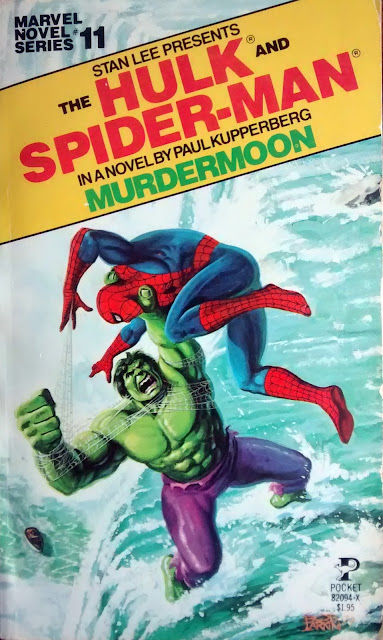
There weren’t many models for writing superheroes in prose. Were they supposed to read like Lowther’s juvenile The Adventures of Superman, or the tongue-in-cheek approach of Lyon/Woolfolk’s Batman books and Binder’s Avengers? Who was the audience? Largely readers of the comics, I assumed, but there was a strong possibility someone without deep knowledge of the Marvel Universe might pick one up based on the TV shows or simple curiosity.
I took Ted White’s The Great Gold Steal as my model. The experienced science fiction writer and editor had set the Captain America starring heist adventure squarely in a realistic, relatable world. Unlike comic books, prose lets readers paint their own mental images of the characters and their environments; to me, the fictional “New York” or “Gotham City” I conjure in my imagination is more realistic than the two-dimensional picture imposed on me by the printed image.
The only advice I can remember Marv and Len giving me was to write the novel I wanted to read. And it quickly became obvious that what worked with four color images on the page can easily turn dull when rendered in words alone. A comic book story holds the reader’s attention with depictions of impossible people and events. Prose dives into characters’ thoughts and emotions with an intimacy hard to achieve in comics.
“I realized you couldn’t concentrate on action as you did in the Marvel Comics ofthe time,” Marv said. “You had to write the characters. It was a real learning process, even as I was rushing through it. There was no time for rewrites, and because of the deadline, I made up the entire plot as I went along, so I wasn’t always sure if it was coherent.”
What started with such promise ended on an odd note, or at the very least on an odd number. “We were contracted to deliver 12 books to Pocket,” Marv said. “But they could only publish 11 of them. There was one more novel, written by the late science-fiction author, cartoonist, photographer, etc. William Rotsler, that was never published. It was a Silver Surfer novel, and it was excellent, but it had been decided at the time that only Stan Lee could write the Surfer, so the book was scrapped. But Bill had done a great job, so it’s a real shame.”
A loss to readers, and an anticlimactic end for the series. The Marvel novels had been released into the world with little or no fanfare. The first two books, before the series was branded with the “Marvel Novel Series” trade dress that graced the rest of the seven Bob Larkin, four Dave Cockrum, and one John Buscema and Peter Ledger covers, received a mention in a Marvel Bullpen Bulletin, but no real effort was made to promotion.
“I don’t think we got any response back then,” Wolfman remembered in 2023. “I get more now from people who bought it back in the 1970s.”
The dearth of superhero novels in the aftermath of the series would seem to back Marv’s memory. There wouldn’t be another book based on a Marvel property until 1986’s novelization of the movie Howard the Duck by Ellis Weiner. DC fared only a little better between 1979 and 1986 with originals, including Elliot S. Maggin’s Superman: Last Son of Krypton and Superman: Miracle Monday and Blackhawk and novelizations of such films as Swamp Thing, Superman III, and Supergirl, some by the same authors who worked on the Marvel Novel Series.
The tide towards superhero novels turned again in the 1990s and into the 2000s, unleashing a flood of books for readers of all ages from Marvel, DC, Image, and other publishers that continues to this day.


Comments